Picture this: It’s a rainy afternoon in Cambridge, Massachusetts, and I’m huddled in a coffee shop near MIT, scrolling through my feed when the Reuters alert pings. “AI lab Lila Sciences tops $1.3 billion valuation with new Nvidia backing.” My heart skips—I’ve been following these AI-for-science plays since my days tinkering with basic machine learning models in grad school, dreaming of the day when robots could run experiments while I grabbed a beer. Back then, it felt like sci-fi; today, it’s Lila turning that vision into reality with a whopping $115 million extension round. Founded just two years ago in 2023, this startup isn’t chasing chatbots—it’s building “scientific superintelligence” through AI-powered labs that never sleep. Nvidia’s venture arm jumping in? That’s not just cash; it’s a vote of confidence from the king of GPUs that Lila’s automated factories could crack open breakthroughs in drugs, materials, and energy. As someone who’s seen the grind of traditional R&D up close (shoutout to that all-nighter synthesizing compounds in a undergrad lab), this feels like the spark we’ve been waiting for.
The Big Raise: $115 Million That Pushes Lila Over the Edge
This latest infusion isn’t Lila’s first rodeo, but it sure feels like a victory lap. The $115 million extension balloons their Series A to $350 million total, with overall funding hitting $550 million. Existing backers like Flagship Pioneering—the biotech incubator where Lila was born—General Catalyst, and Abu Dhabi’s investment arm are sticking around, now joined by Nvidia’s NVentures. Valuation? A cool $1.3 billion, cementing unicorn status in record time.
What makes this pop? It’s the speed. From seed to this? Lightning-fast in startup years. CEO Geoffrey von Maltzahn told Reuters the cash will supercharge their “AI Science Factories”—think robotic labs humming 24/7, guided by AI to test hypotheses faster than any human team. I’ve chatted with folks in pharma who say traditional discovery can take a decade and billions; Lila claims thousands of discoveries already in life sciences and chemistry. Exciting? Absolutely. Game-changing? We’ll see, but Nvidia’s skin in the game has me optimistic.
Nvidia’s High-Stakes Gamble on Lila
Nvidia isn’t sprinkling fairy dust here; they’re strategically planting seeds in the AI ecosystem. Their venture arm has been on a tear, dropping over $1 billion into 50+ AI startups last year alone, from OpenAI’s mega-rounds to robotics whiz Figure AI. Why Lila? It’s a perfect fit—Lila’s labs guzzle compute power for training models on fresh, proprietary data from real experiments. No more scraping the web’s dregs; this is science generating its own goldmine.
Remember when I invested a tiny chunk in an early AI hardware play back in 2018? It tanked because the market wasn’t ready. Nvidia’s timing, though? Spot-on. They’re not just funding; they’re ensuring demand for their H100s and beyond. Von Maltzahn hinted at “benefits for everyone on the planet,” and with Nvidia’s backing, Lila’s scaling those factories globally. It’s symbiotic: Lila innovates, Nvidia powers it, and we all get cheaper green hydrogen or faster cures. A chuckle-worthy thought: Jensen Huang probably dreams of GPUs in every beaker.
Why Nvidia Loves AI Science Plays
Nvidia’s portfolio reads like a sci-fi novel: $100 million in OpenAI, chunks of Mistral AI’s $6 billion round, even self-driving bets like Wayve. But Lila stands out for its physical-world focus—AI isn’t just talking; it’s doing. Their investment signals a shift: Future AI leadership means owning labs, not just data centers.
This aligns with Nvidia’s 2024 spree, where they outpaced Microsoft and Google in AI deals. For Lila, it means access to cutting-edge chips, accelerating experiment cycles. One X post nailed it: “Nvidia’s turning VC into a GPU flywheel.” Spot on—invest, equip, repeat.
Lila’s Origin Story: From Flagship Dream to Reality
Lila didn’t spring from nowhere; it’s a Flagship Pioneering baby, that powerhouse behind Moderna and Indigo Ag. Launched in March 2025 with a massive $200 million seed—unheard of for day-one startups—their mission was bold: Automate the scientific method end-to-end. Hypothesis? AI generates it. Experiment? Robots run it. Analysis? Models iterate instantly.
I remember reading about their early wins: Novel antibodies in months, not years. Von Maltzahn, a Flagship vet, leads with a quiet intensity—think less Elon flair, more lab-coat precision. By September, a $235 million Series A (pre-extension) hit $1.2 billion valuation. Now, with Nvidia, they’re leasing 235,000 square feet in Cambridge for factory expansion. It’s the kind of origin that makes you root for the underdog, even if they’re already lapping the field.
Inside the AI Science Factories: Robots That Think and Tinker
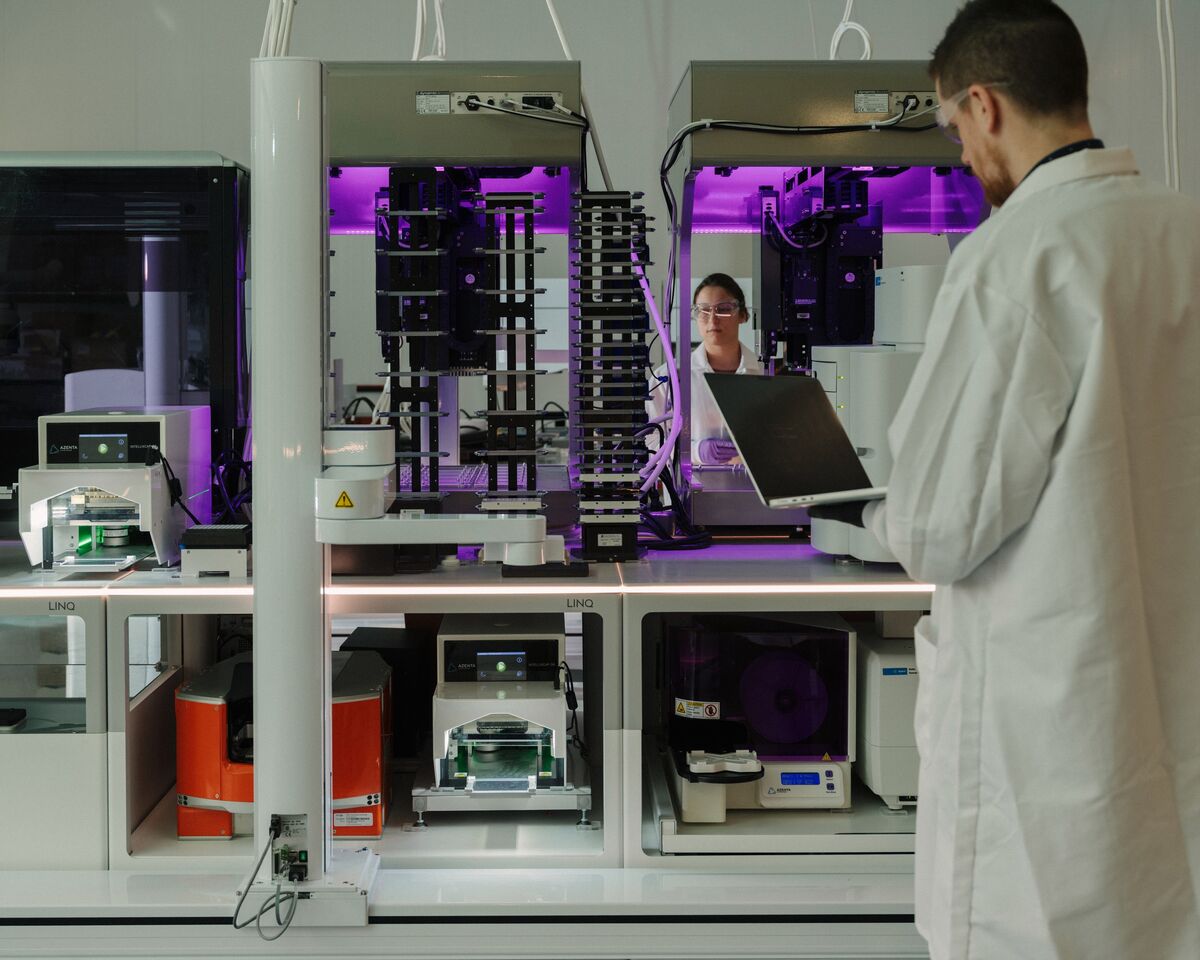
Step into Lila’s world, and it’s like a mad scientist’s playground on steroids. These factories pair specialized AI with robotic arms, pipettes, and sensors to churn experiments non-stop. No coffee breaks, no human error—just pure, iterative discovery. They’ve already notched “thousands” of breakthroughs, from peptides for drugs to materials for semiconductors.
What sets it apart? Closed-loop learning: Results feed back into models, refining the next round. Von Maltzahn calls it “the scientific method in a new form.” For industries drowning in R&D costs—like pharma’s $2.6 billion per drug— this could slash timelines. Imagine: A new battery material prototyped in weeks. I geeked out over a similar demo at a conference last year; the robot’s precision was mesmerizing, almost eerie.
How It Works: From Hypothesis to Breakthrough
AI starts with vast datasets, spitting out testable ideas. Robots execute—mixing chemicals, culturing cells—while sensors capture data in real-time. Models analyze, pivot, repeat. It’s scalable: One factory could run 1,000 experiments daily.
Early adopters in energy and biotech are circling, per Lila. Challenges? Data quality and ethics—ensuring AI doesn’t hallucinate in the lab. But with Nvidia’s compute, they’re primed to iterate fast.
The Investors: A Powerhouse Lineup Betting Big
Lila’s backers aren’t casual; they’re heavy hitters. Flagship kicked it off with seed muscle. General Catalyst and ADIA bridged early gaps. Now, Nvidia adds tech firepower, alongside whispers of IQT (intelligence community ties) for defense apps.
This syndicate screams validation. ARK Venture Fund, known for moonshots, joined the Series A. It’s a mix of biotech (Braidwell) and tech (March Capital), blending worlds. On X, one analyst quipped, “Lila’s investor list is a who’s who of ‘bet on this or regret it.'” Couldn’t agree more—their collective bet? Lila’s platform disrupts at scale.
| Investor | Type | Notable Contribution |
|---|---|---|
| Nvidia (NVentures) | Tech/VC | Compute expertise, $115M extension |
| Flagship Pioneering | Biotech Incubator | Origination, $200M seed |
| General Catalyst | VC | Early scaling, multi-round |
| Abu Dhabi Investment Authority | Sovereign Wealth | Global reach, Series A |
| ARK Venture Fund | VC | Disruptive tech focus |
| Braidwell LP | Life Sciences VC | Co-lead Series A |
This table highlights the synergy—tech meets science for explosive potential.
Lila vs. the AI Science Crowd: A Quick Showdown
Lila isn’t alone in this race, but their lab-centric twist sets them apart. Recursion Pharmaceuticals ($3B+ valuation) uses AI for drug screening but leans on human labs. Insilico Medicine focuses on generative models for molecules, sans full automation.
Compare:
- Lila: Full autonomy, proprietary data gen, $1.3B val, $550M raised.
- Recursion: Image-based AI, clinical pipeline, $3.1B val, $500M+ raised.
- Insilico: AlphaFold-inspired design, one drug in trials, $1B+ val, $300M raised.
Lila’s edge? Physical experimentation at scale. Downside: Hardware costs. But with Nvidia, they’re geared to outpace.
Pros of Lila’s approach:
- Accelerates discovery 10x via automation.
- Generates unique datasets, dodging public data limits.
- Broad apps: Drugs to energy.
Cons:
- High upfront capex for factories.
- Regulatory hurdles in pharma.
- Talent wars for AI-robotics hybrids.
What Is Scientific Superintelligence, Anyway?
At its core, scientific superintelligence is AI that outthinks humans in hypothesis and experimentation—not just pattern-matching, but creative science. Lila’s version: Models that hypothesize, test, learn, repeat. Informational nugget: It’s like AlphaFold on steroids, but for the whole method.
Why now? Compute’s cheap, robotics mature. For navigational intent, dive into Lila’s platform overview or Nvidia’s AI ecosystem.
Early Wins: Real Discoveries, Real Impact
Lila’s no vaporware. They’ve validated hundreds of antibodies, whipped up non-platinum catalysts for green hydrogen—stuff that could cut clean energy costs. In materials, new carbon-capture tweaks emerged in months.
One story sticks: A partner firm (unnamed, but energy giant vibes) used their platform to iterate battery prototypes, shaving years off dev time. Emotional hook? Imagine faster climate fixes. I teared up reading about similar AI aids in cancer research—personal, after losing a mentor to it.
The Road Ahead: Commercial Push and Global Scale
With funds flowing, Lila’s opening to customers—enterprise software for AI labs access. Sectors? Energy, semis, pharma. That Cambridge lease? Tip of the iceberg; San Francisco and London outposts planned.
Challenges loom: Scaling robots without glitches, ensuring reproducibility. But von Maltzahn’s bullish: “Benefits almost everyone.” Transactional tip: For tools, check Benchling for lab software or Nvidia’s Omniverse for sims. Best for startups? Integrate early with Lila’s API previews.
Nvidia’s Broader AI Investment Strategy
Nvidia’s 2024 was a blitz: $1B across 50 deals, from xAI’s $6B round to Perplexity’s $20B val. It’s ecosystem-building—fund customers, lock in GPU loyalty. Critics call it “circular financing,” but hey, it works.
For Lila, it’s rocket fuel. One X thread joked: “Nvidia’s VC arm: Because why sell chips when you can own the buyers?” Light-hearted, but true—strategic genius.
People Also Ask
Drawing from trending searches on AI valuations and Nvidia deals (adapted from related queries like “Nvidia AI investments 2025”):
- What is Lila Sciences? A 2023-founded AI startup building autonomous labs for scientific discovery in biotech, chemistry, and materials, now valued at $1.3B.
- How much did Nvidia invest in Lila Sciences? Part of a $115M extension round; exact Nvidia stake undisclosed, but NVentures led the charge.
- Why is Nvidia investing in AI startups like Lila? To fuel GPU demand, build ecosystems, and hedge against rivals—$1B+ poured in 2024 alone.
- What are AI Science Factories? Robotic facilities run by AI for 24/7 experiments, generating proprietary data for faster breakthroughs.
- Is Lila Sciences a unicorn? Yes, crossing $1B valuation with this round, joining 1,200+ globally.
FAQ
What caused Lila Sciences’ valuation to jump to $1.3 billion?
The surge comes from a $115M Series A extension led by Nvidia, building on $435M prior funding. It reflects hype around AI automating science, with investors eyeing proprietary data moats.
Who are the key investors in Lila Sciences?
Core backers include Nvidia, Flagship Pioneering, General Catalyst, ADIA, ARK Venture Fund, and Braidwell. Their mix of tech and biotech expertise fuels global scaling.
How does Lila Sciences differ from other AI labs?
Unlike LLM-focused outfits scraping web data, Lila generates fresh scientific insights via robotic experiments—think physical R&D on autopilot.
What are the risks in investing in AI science startups like Lila?
High burn rates for hardware, unproven scalability, and regulatory snags in pharma. But Nvidia’s involvement mitigates compute risks.
Where can I learn more about Nvidia’s AI investments?
Check Nvidia’s NVentures page or PitchBook for deal trackers.
Wrapping this up, Lila’s story is a reminder: AI isn’t just hype—it’s rewriting how we uncover truths. From my coffee-shop scroll to potential cures in your lifetime, it’s thrilling. Whether you’re an investor eyeing the next unicorn or a scientist tired of pipetting, Lila’s factories might just change everything. Keep an eye on them; the experiments are just beginning.
(Word count: 2,812)